¶ How to Play MiniBridge on Bridge Champ


🏫 Do you teach beginners? MiniBridge is where most teachers start a new group, because students play real cards from the first minute and the bidding can wait. Bridge Champ has a full set of teaching tools built around that: run the lesson on a Teaching Table where you see every hand, and see For Teachers for the rest.
¶ 🃏 Introduction
Welcome to Bridge Champ!
MiniBridge is a fast, beginner-friendly way to enjoy the game of bridge, without having to learn the complex bidding system.
In MiniBridge, you jump straight into card play:
- Declarer: You play both your own hand and your partner’s (the dummy).
- Defense: You work with a bot partner to stop the declarer.
Everything you learn here will help you build a strong foundation for full bridge, from counting points to understanding strategy.
¶ 🚀 Getting Started
¶ Step 1: Open MiniBridge
You can start a MiniBridge game in two ways:
- From the main page, click Play Now, then choose MiniBridge.
- Or go to the Casual section → click Play Now → then select Play MiniBridge.

¶ Step 2: Pick a variant and your role
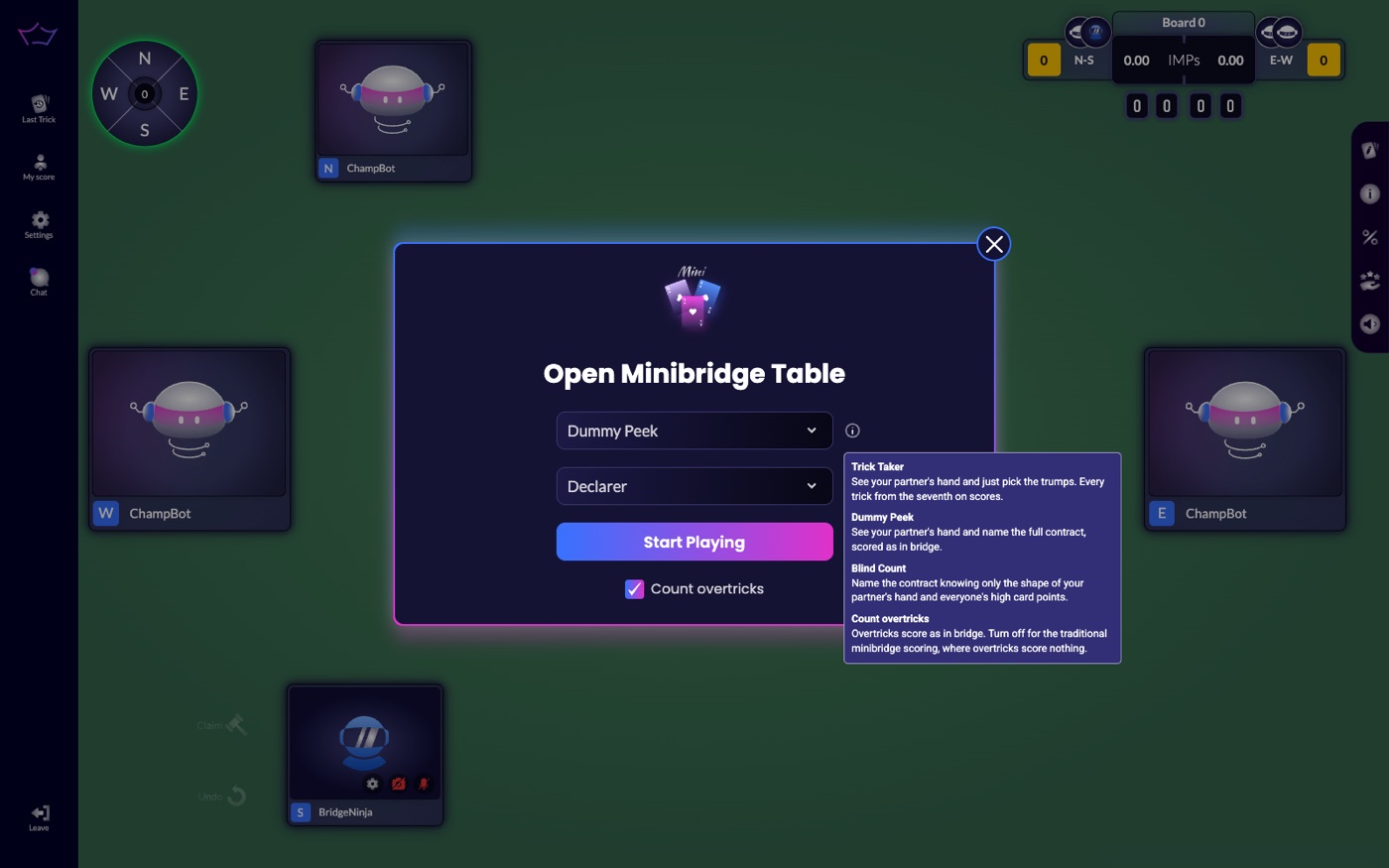
A table with three bots opens and a small window, Open Minibridge Table, asks three things:
- Variant: Trick Taker, Dummy Peek or Blind Count. They differ in how much you see of your partner's hand before you name the contract, and in how the board is scored. The small i next to the list shows a one-line reminder of each one. All three are explained below.
- Declarer or Defender: as Declarer you name the contract and play both hands on every board. As Defender a bot declares and you defend with a bot partner.
- Count overtricks: ticked, overtricks score as in bridge. Untick it for traditional minibridge scoring, where overtricks score nothing. In Trick Taker the box is locked on, because there every trick counts.
Click Start Playing.
¶ The three variants
Minibridge has no auction: the declarer simply names the contract. The variants change what the declarer knows at that moment and how the result is scored. Pick the one that matches where you are in your learning.
| Trick Taker | Dummy Peek | Blind Count | |
|---|---|---|---|
| Before the contract you see | Your partner's cards | Your partner's cards | Only the shape of your partner's hand (how many cards in each suit) and the high card points of all four players |
| You name | The trump suit, or no trumps | The trump suit and the level, 1 to 7 | The trump suit and the level, 1 to 7 |
| Scoring | Every trick from the seventh scores for you, every trick short of seven costs you | As in bridge: make the contract or go down | As in bridge: make the contract or go down |
| Good for | A first lesson: play the cards and watch the tricks | Learning levels, games and slams with the dummy in view | The last step before bridge: counting points and shape |
Whichever variant you choose, the play itself is the same as in bridge: the player to the left of the declarer leads, the dummy goes face up, and you must follow suit.
¶ Trick Taker
The simplest variant. You see your partner's hand from the start and only answer one question: which suit should be trumps, or no trumps. There is no level to name.
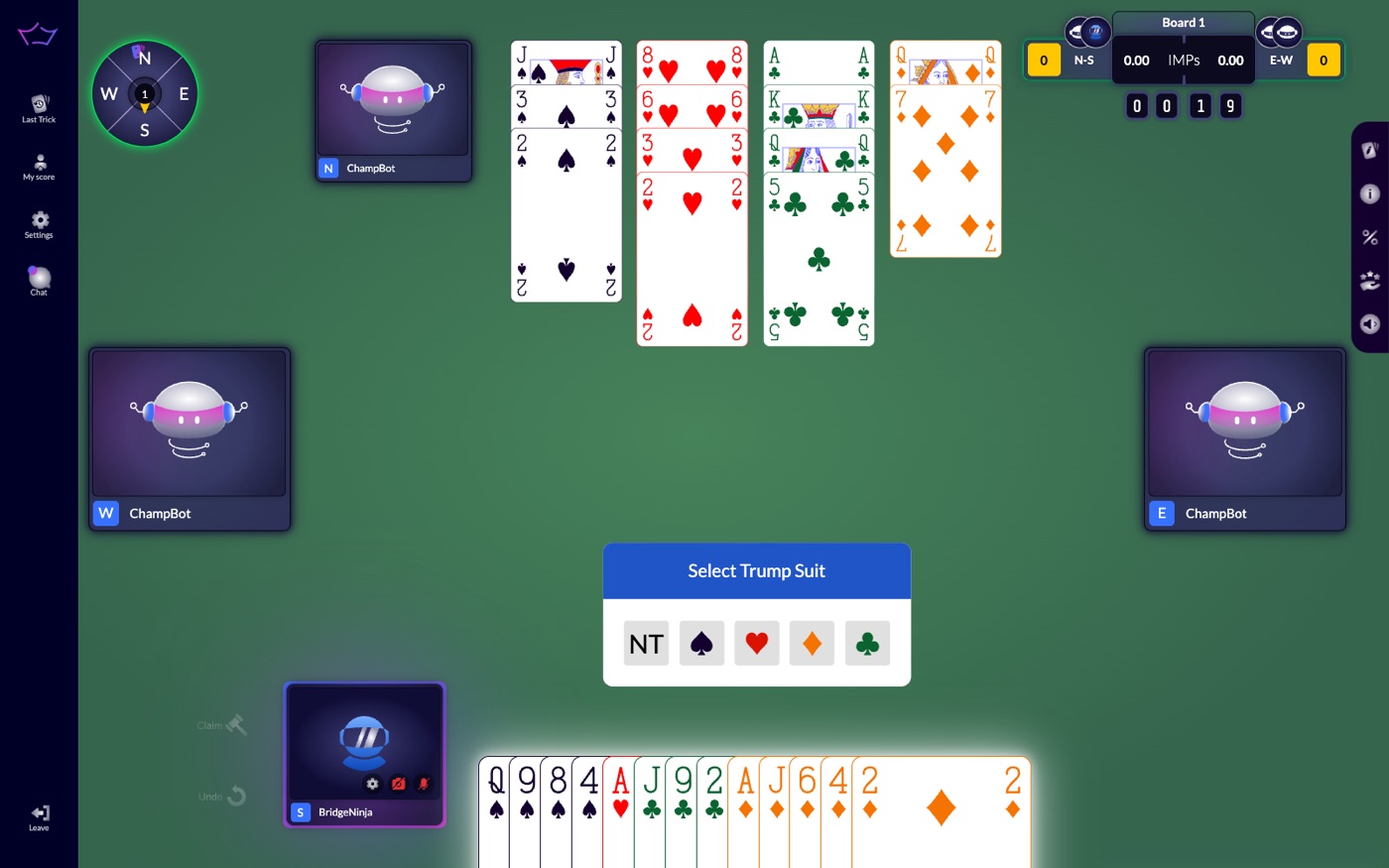
- Look at both hands and click NT or a suit in the Select Trump Suit panel.
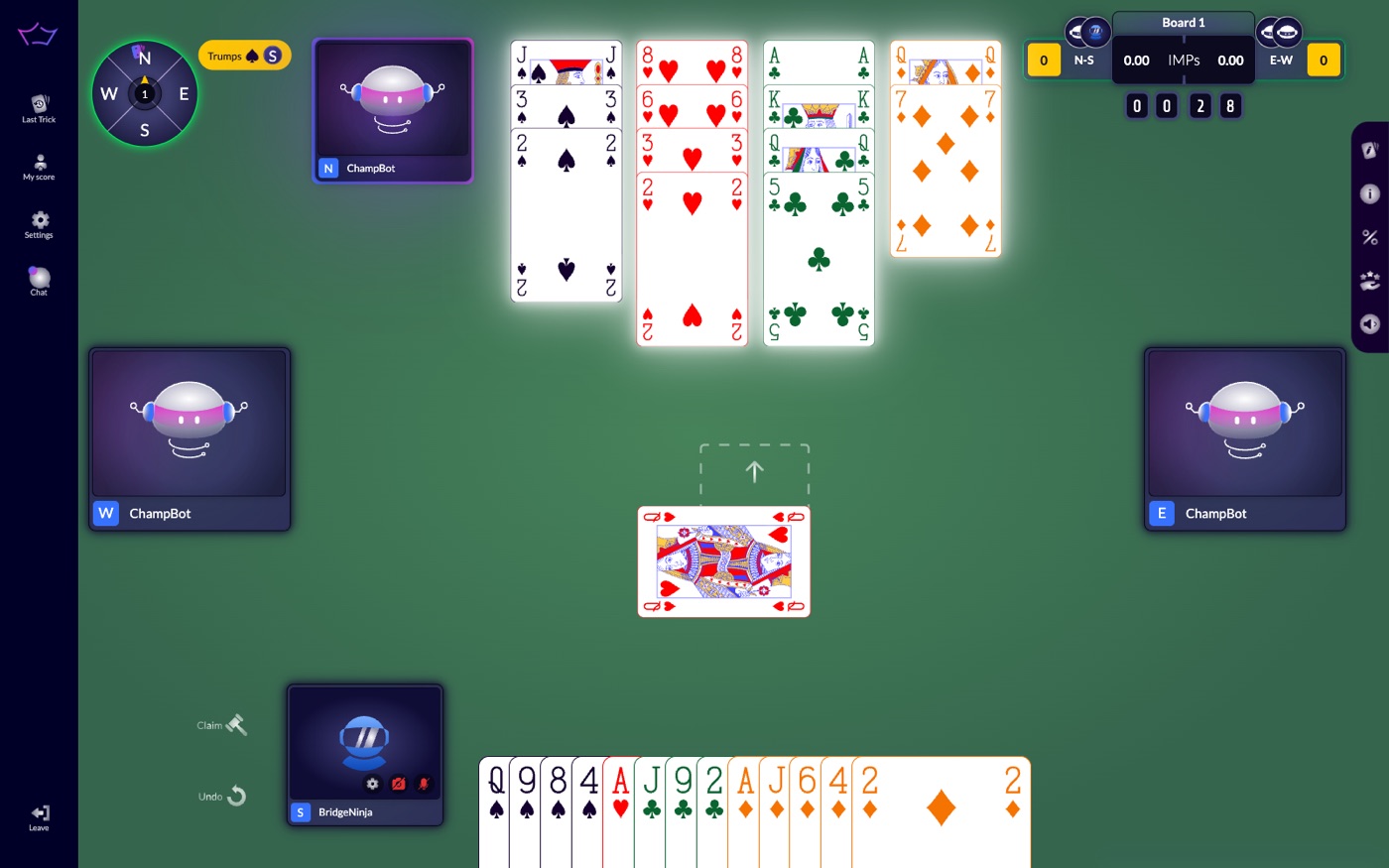
- Play begins at once. The badge next to the compass reads Trumps with your suit, and you play both hands against the two bots.
- Take as many tricks as you can. Your goal, shown at the start, is Take at least 7 tricks: every extra trick scores.
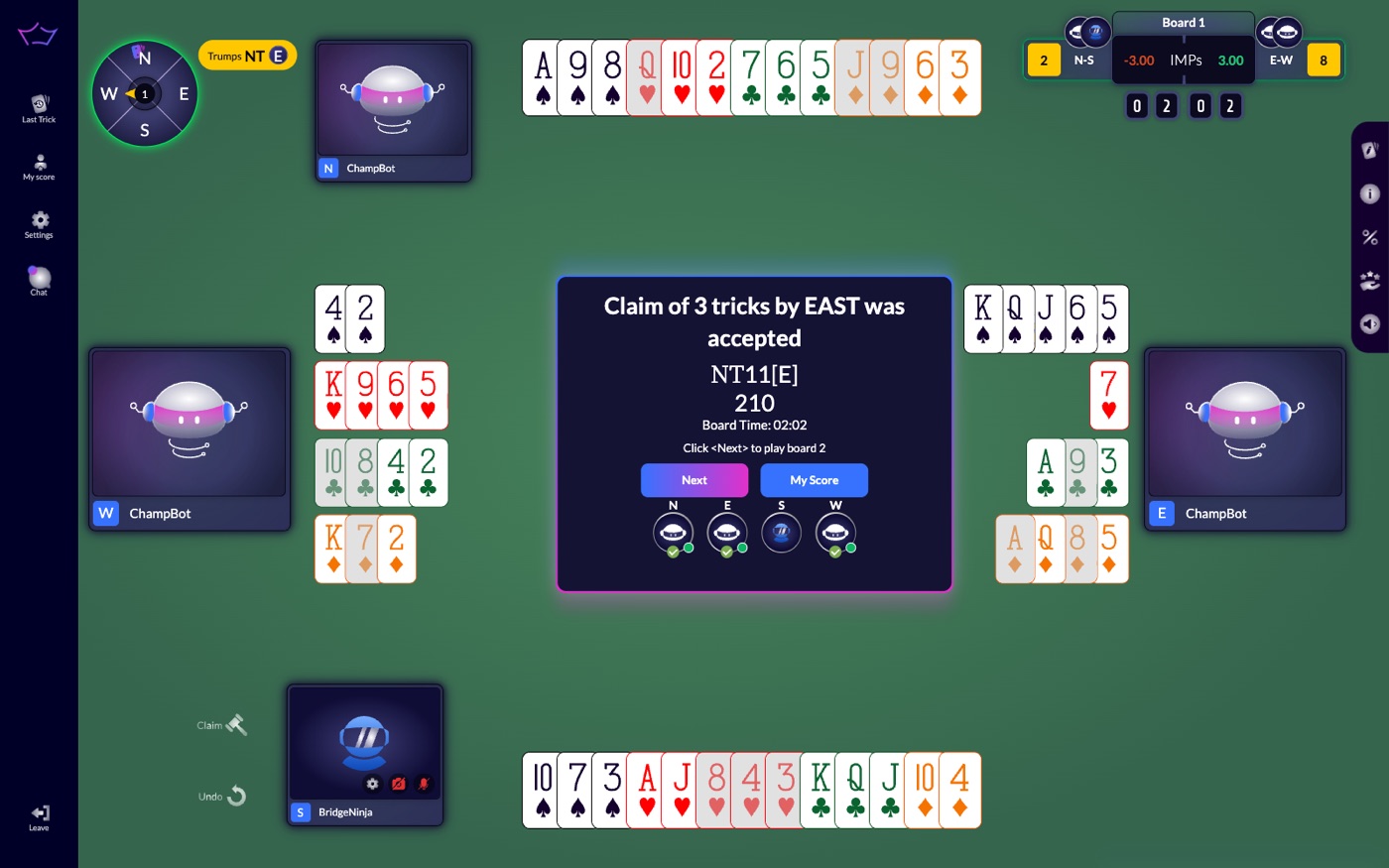
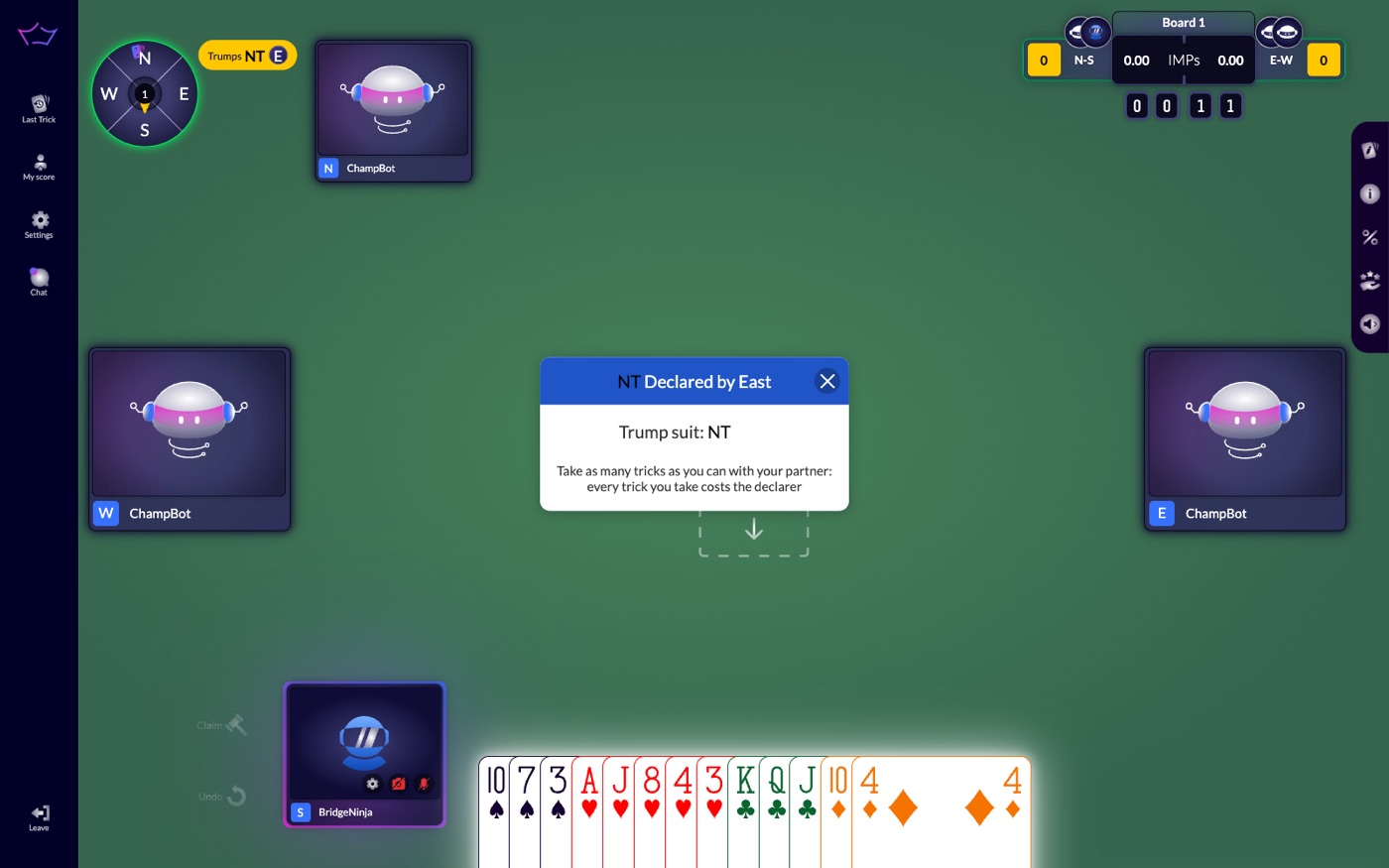
How it is scored. Think of it as a part score in bridge. Each trick from the seventh earns the usual trick points (30 in a major suit or no trumps, 40 for the first trick in no trumps, 20 in a minor) plus the 50 point part score bonus. For example, eleven tricks in no trumps scored 210 in the board below. Each trick short of seven counts against you like an undertrick: two tricks with spades as trumps scored minus 250. There are no game or slam bonuses, so the level you would have bid does not matter: only the tricks do.
As a defender a bot names the trumps and the panel tells you your job: Take as many tricks as you can with your partner: every trick you take costs the declarer. There is no contract to beat, every trick you win is worth points.
¶ Dummy Peek
You still see your partner's hand before you decide, but now you name a full contract, suit and level, and the board is scored exactly as in bridge. Bid a game when the two hands look strong enough, stay low when they do not.
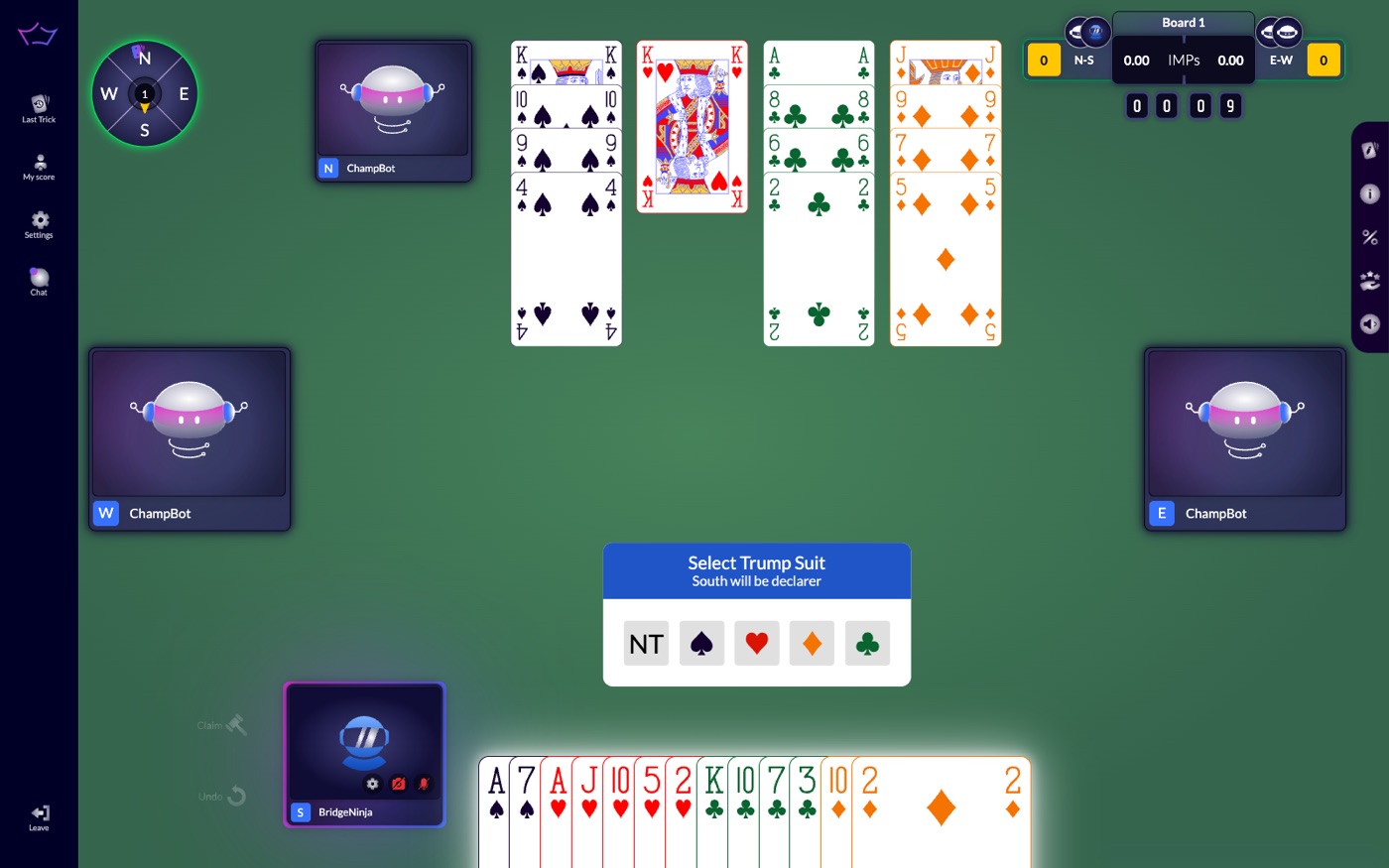
- Choose the trump suit or NT. The panel says South will be declarer.
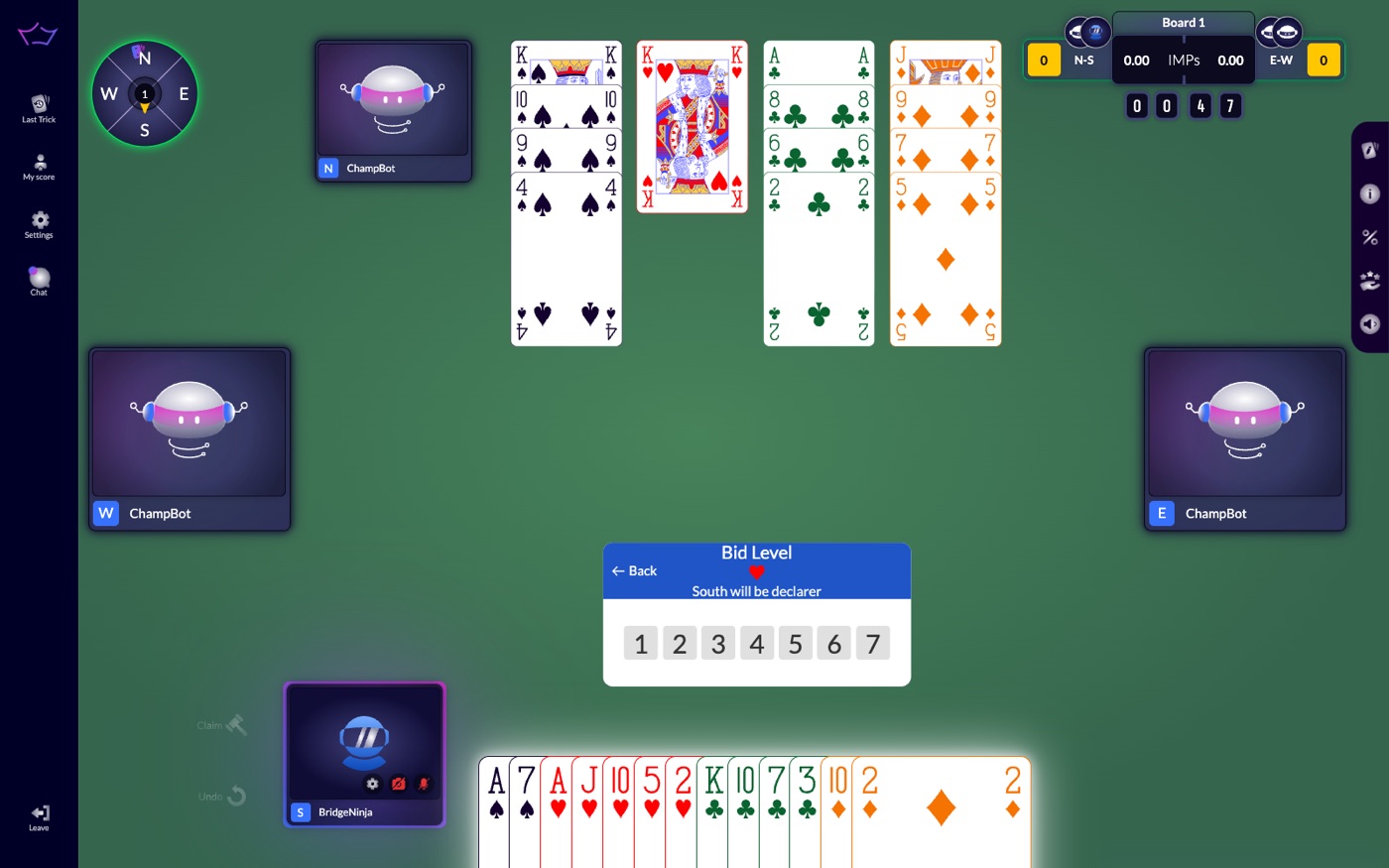
- The panel changes to Bid Level: click 1 to 7. Back returns to the suit choice if you change your mind.
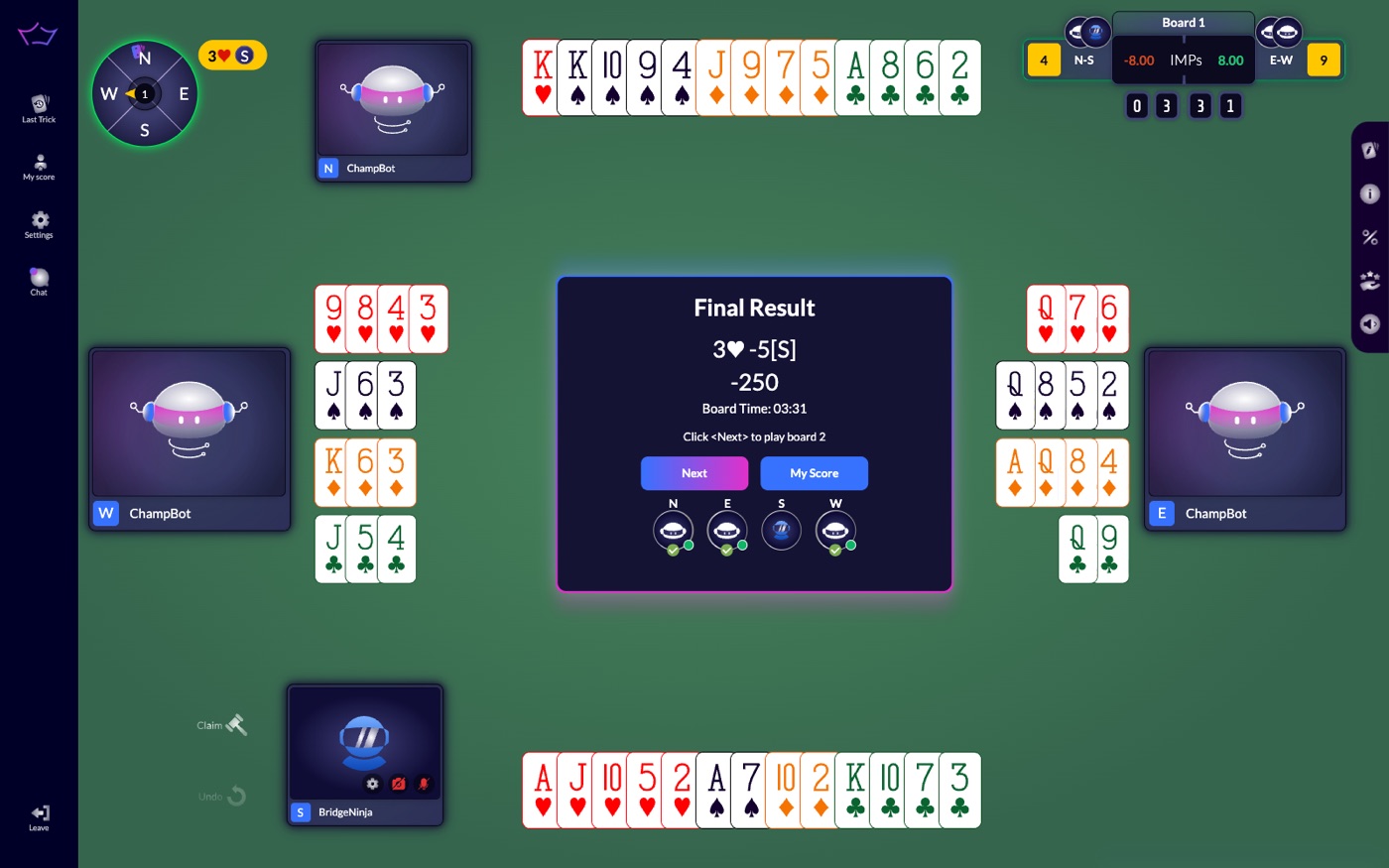
- The contract, for example 3♥ S, appears next to the compass and the opening lead is made. Play both hands as in bridge.
How it is scored. Bridge scoring: trick points for the contract, the part score, game or slam bonus if you make it, and undertricks if you do not. With Count overtricks ticked, every extra trick is worth points too; unticked, you get the contract and nothing more.
As a defender a bot names the contract and the panel tells you how many tricks you and your partner need to beat it.
¶ Blind Count
The closest to real bridge. Before you name the contract you do not see your partner's cards. Instead the dummy is shown as four face-down piles with the number of cards in each suit, and every player has a badge with their high card points. From that you work out the combined strength and the fit, exactly the reasoning an auction is for, and you name the contract.
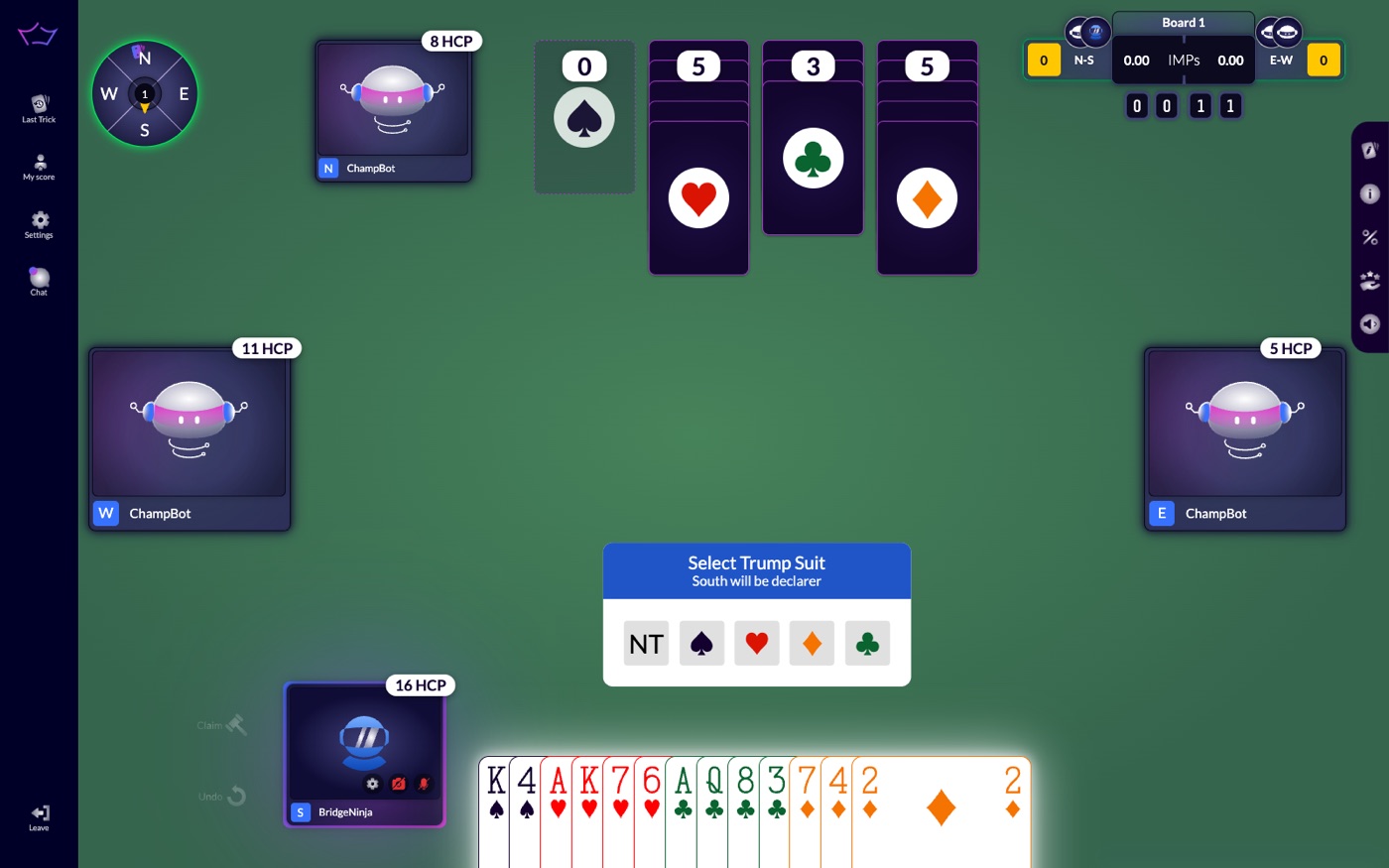
- Add your points to your partner's, look at the shape, and choose the trump suit or NT.
- Choose the Bid Level, 1 to 7, as in Dummy Peek.
- Once the contract is named, the dummy goes face up and you play both hands. The HCP badges stay on the table during the play.
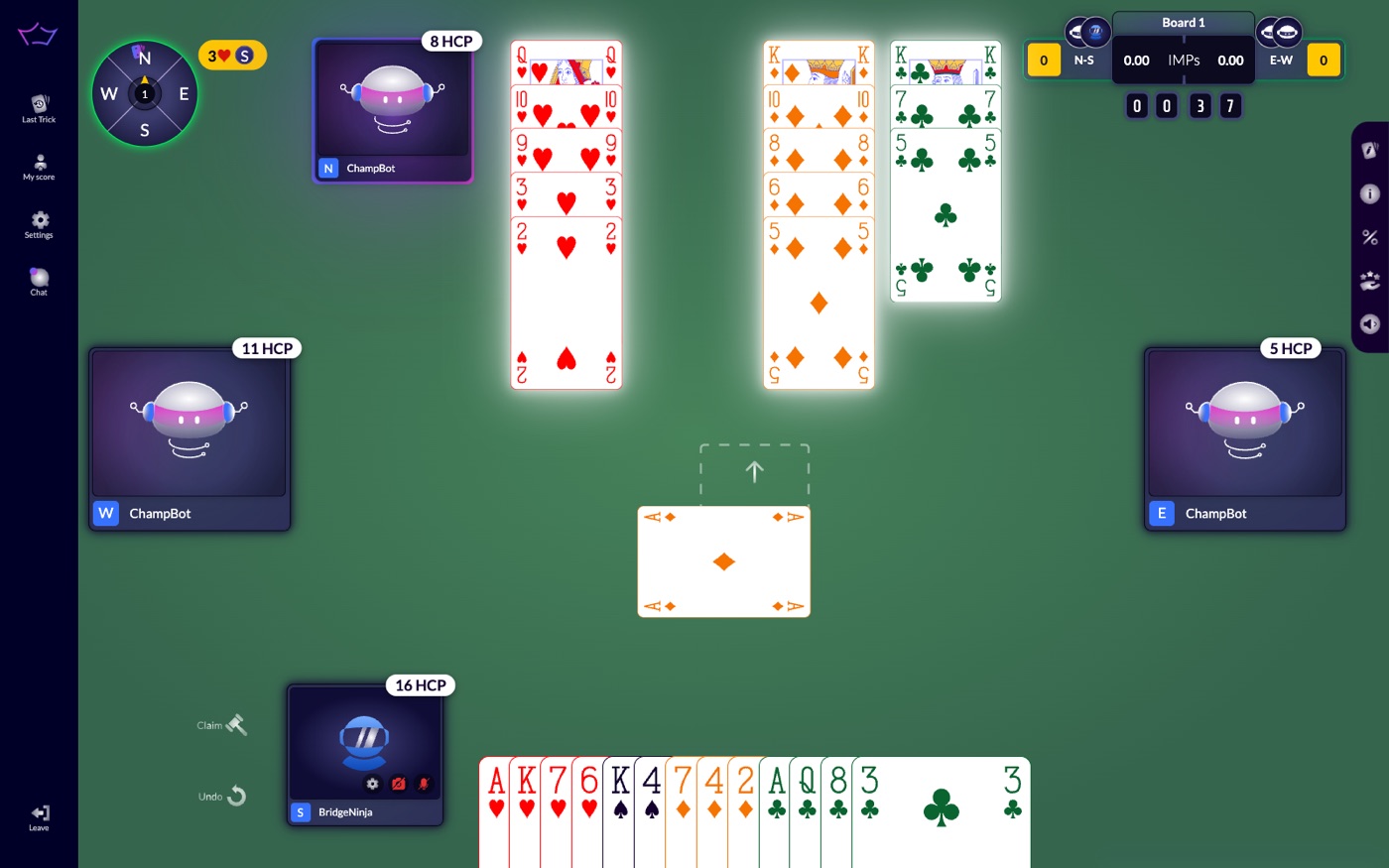
How it is scored. As in bridge, like Dummy Peek. In the board above the contract was three hearts with Count overtricks off, and the result, three down, was minus 150: undertricks always count, it is only overtricks that the setting switches off.
¶ Count overtricks, and where to check the settings
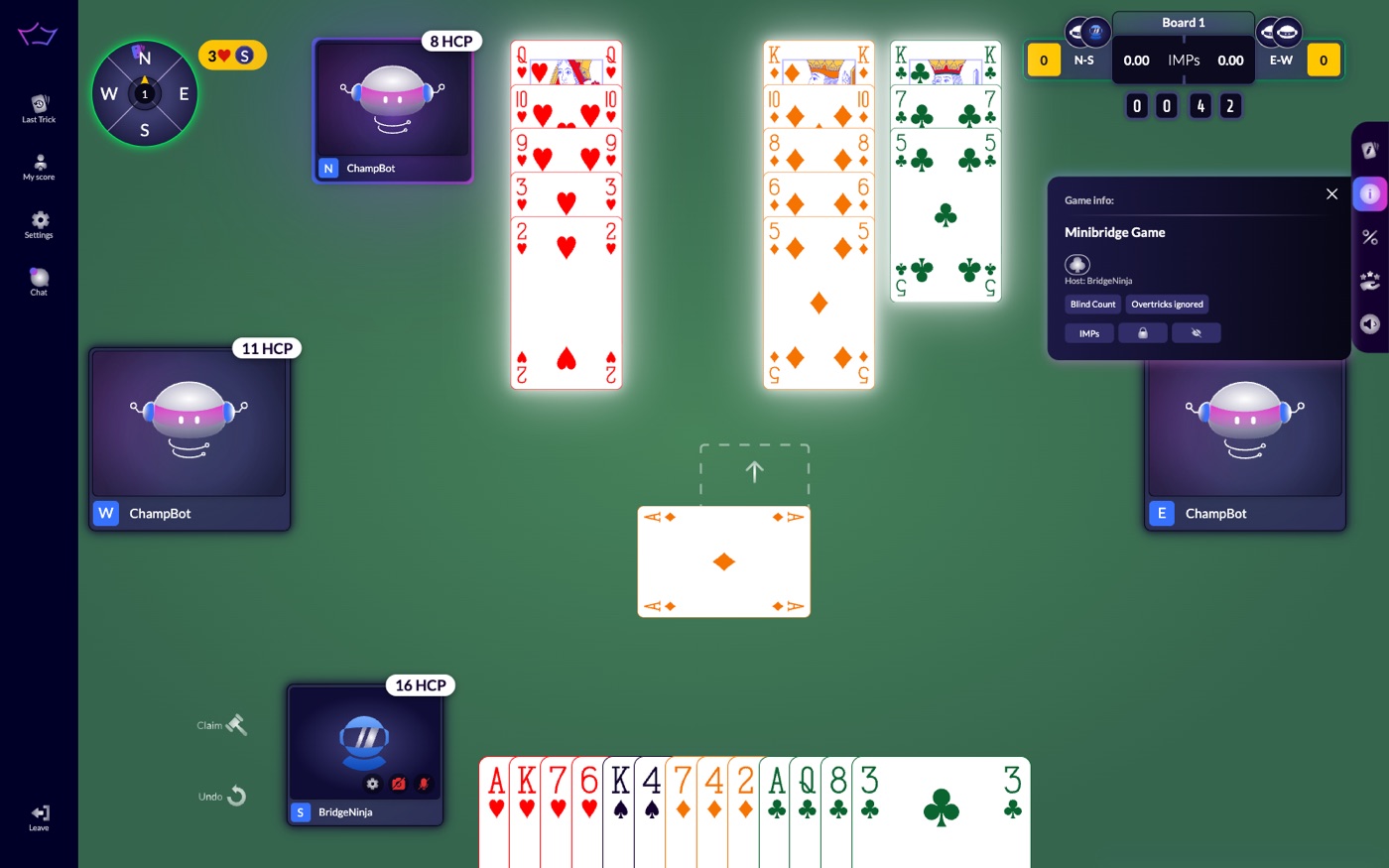
Traditional minibridge, as taught in many clubs, only scores the contract: overtricks are worth nothing, which keeps beginners focused on making what they bid. Bridge Champ lets you choose. With Count overtricks ticked, overtricks score as in bridge. Untick it for the traditional rule. The i button on the right of the table opens Game info, which shows the variant and, when overtricks are off, the tag Overtricks ignored.
¶ 🕹️ Playing as Declarer

- See your cards and, depending on the variant, your partner's cards or only their shape and points.
- Choose a trump suit or No Trump.
- Except in Trick Taker, select the contract level (tricks above six).
- Play the hand against bot defenders.
- After the hand you see the contract, the tricks won and the score.
Click Next to play the next deal. In the Play Now game you are the declarer on every board.
¶ 🛡️ Playing as Defender

- A bot names the contract and declares.
- You lead the first card when it is your turn, and play with a bot partner.
- The panel at the start tells you the target: how many tricks beat the contract, or in Trick Taker, that every trick you take costs the declarer.
- In tournaments and challenges the declarer is not chosen by you. If your bot partner turns out to be the declarer on a board, Bridge Champ tells you so and hands you the job: you choose the contract and play the hand for your partner.
¶ Minibridge at a casual table
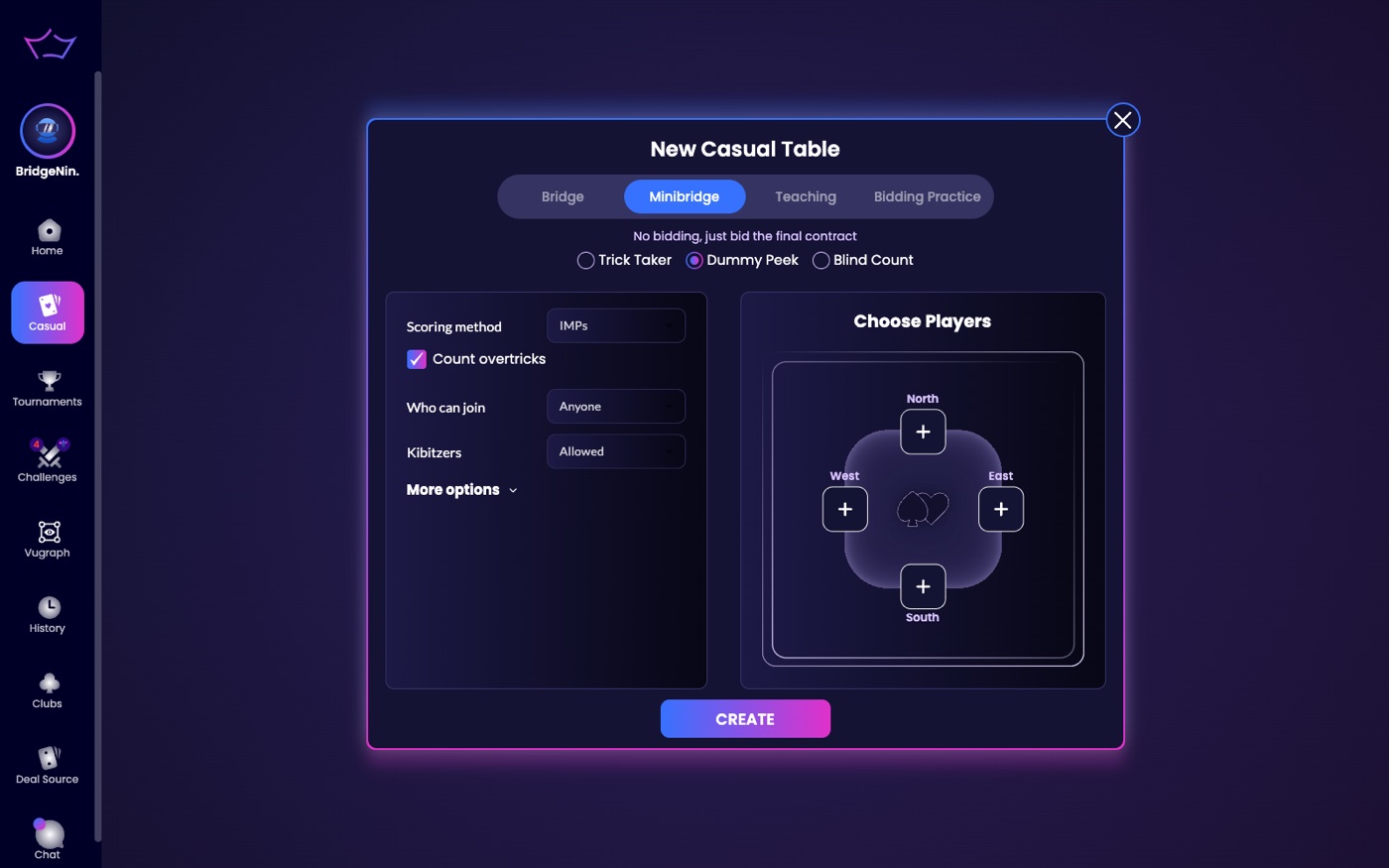
To play minibridge with friends instead of three bots, go to Casual, click Start New Table and open the Minibridge tab. Pick the variant, tick or untick Count overtricks, and under Choose Players seat your friends or leave seats to bots. All three variants are open to every player. The table tells everyone who will be declarer on each board; the others wait while that player names the contract. If you host the table, you can remove a player from it. The same variants exist in challenges, in tournaments and in the mobile app.
¶ 🏆 Creating a MiniBridge Tournament
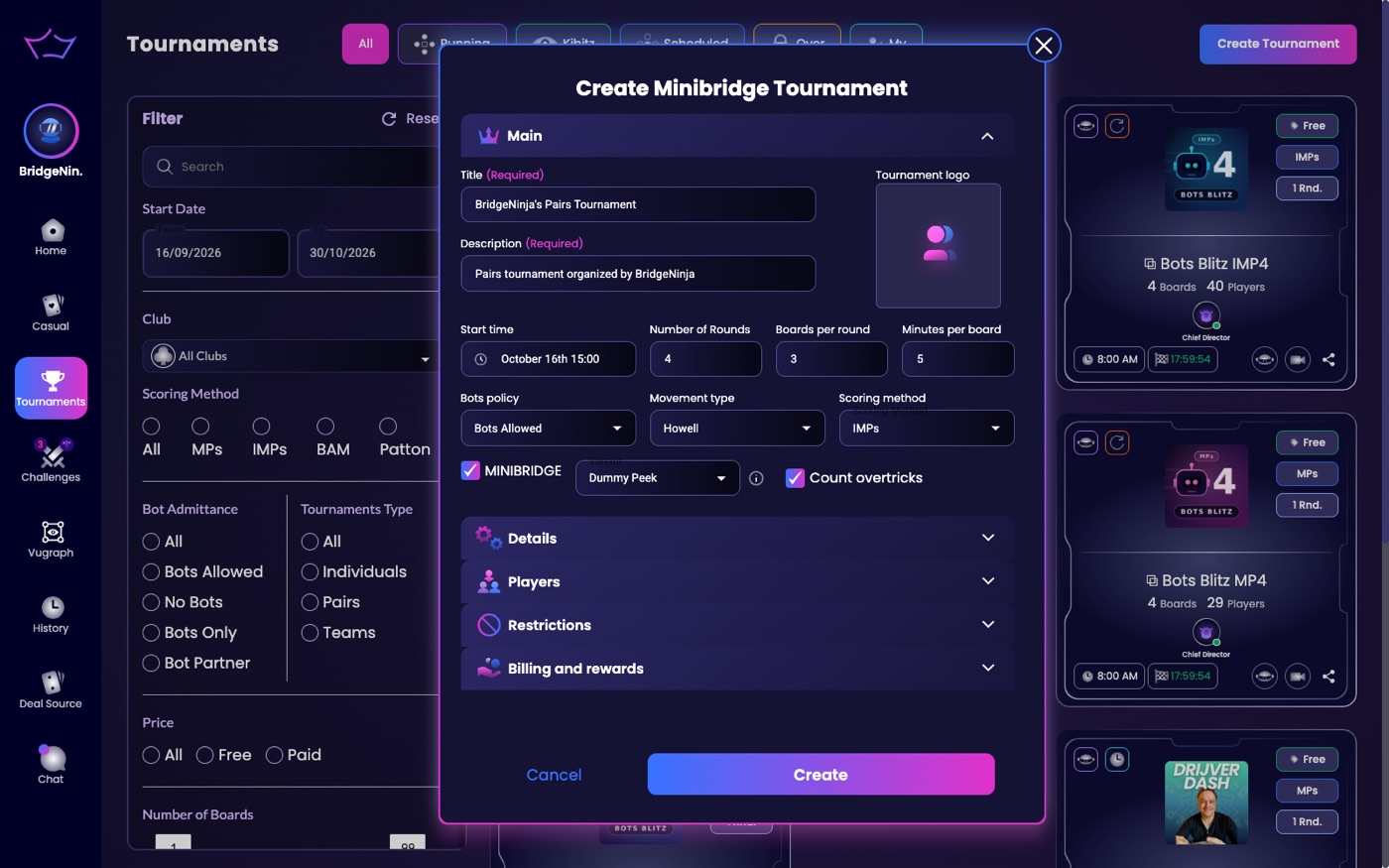
You can create MiniBridge tournaments on Bridge Champ:
- Go to the Tournament section.
- Click Create Tournament.
- Pick any tournament type, then tick the MINIBRIDGE switch in the Main section of the form.
- Customize settings like boards, scoring, and roles. For scoring you can choose normal bridge scoring or traditional minibridge scoring, where overtricks do not count: tick or untick Count overtricks.

¶ 🎮 MiniBridge in Challenges
To play MiniBridge in a Challenge, just tick the MiniBridge box when creating the challenge.

¶ Related guides
- Teaching Tables: run a live lesson where you see and play every hand.
- Projection Table: show the class a clean screen and reveal hands one at a time.
- Classes: group your beginners and reserve tables just for them.
- For Teachers: all the teaching tools in one place.
¶ 🎯 Ready to Play?
You now know the basics of MiniBridge on Bridge Champ.
It’s a great way to learn, practice, and enjoy bridge, whether you’re a complete beginner or brushing up on your skills.